
Hi! Welcome to the 4 CreativeWheels newsletter — your weekly dose of insights on creativity and fuel for your creative journey.
Week #45, it is! On March 14th, we reached 2 years of existence. From those who were here since the beginning to those who just hopped in, I’m thankful for all of you. Lately, I’ve learned some Spanish words and phrases. One of my favorite ones is “Mañana será mejor.“ I’m looking forward to the future! With that said . . .
In this week’s issue, we explore how impactful looking at one thing through a different image or perspective is and how we can replicate that result.
“The primary reason why the trains worked so well was that they moved me from my present and painful situation to a similar but more hopeful circumstance. So, I was no longer thinking of my present situation. I was now transferred to a place that feels the same without the suffering. It was as if I were the main character while still being able to have a third-person point of view. Simultaneously, I was living it and being detached. And this outcome can be done even outside the realm of wholesome counsel. With the right actions, you can produce the same result in a different field.“
Without further ado…
Let’s start the ride!
Main Wheel

A few weeks ago, I was doomscrolling. I know this activity is never a helpful one. But on that day, against conventional wisdom, the activity led to a positive event. The event was prompted by one specific reel. The video was a simple, uplifting piece. And that was what I needed to start the premise of my reflection.
Unfortunately, I cannot remember the name of the creator. What I do remember is that it was a young lady. Her main message was having a positive perspective on “failures.” And one of the supporting messages was that we are all where we are meant to be. Failures can be what lead us to our breakthroughs. Nice message, a cliché one, one could argue. As much as I needed to hear that, it was not the message that stood out to me. What stayed with me was the metaphor she used. And that metaphor opened up the door for thoughts to spring within my mind.
Trains were the main elements of the lady’s metaphor. She offered a scenario. It was a switch in perspective. And it all happened with this question, "Are you late to your train or are you just early to the next one?" She ended with, I paraphrase, “You can miss a few trains so that you can get onto the right one.” That clicked. It helped me reframe my situation.
That question propelled me to reflect on the power of mental pictures and perspectives. She listed examples of Dr. Seuss, Steve Jobs, and J. K. Rowling to support her reasoning and the message. Yet, in my mind, I started constructing the scenario and why it was a good concept to adopt. Perhaps that was the train I needed to get onto.
Imagine you were running after a train. And when you arrive, you see that it’s already gone. Normally, when you miss a train, it feels devastating. You ran so fast. You hurried. You tried everything you could to arrive as soon as possible, but you still didn’t make it. You were late for your train. Your goal was not reached. And you missed the chance to go to your destination. You miss the chance to move forward.
However, when I replaced the normal frame with the lady’s analogy, I was uplifted. With her perspective, the efforts, time, and energy you invested into getting onto the first train were not a waste. You hurried. You did everything you could and missed it. Now, guess what? You arrived early for the right train. You can now even rest. You can prepare, give yourself time to settle, and make the best of your time in the waiting. You can even orchestrate what you can do to make the coming ride the best one yet. And that was powerful.
It’s the same situation, same context, same trains. The only distinction is the image in one’s mind. I know it’s an ancient truth. Still, I cannot help but be amazed by that. And as always, I would think about how it applies to creativity and one’s craft. If it applies to general and normal life, there must be a way to use it in other specific areas. Fortunately, there is.
The primary reason why the trains worked so well was that they moved me from my present and painful situation to a similar but more hopeful circumstance. So, I was no longer thinking of my present situation. I was now transferred to a place that feels the same without the suffering. It was as if I were the main character while still being able to have a third-person point of view. Simultaneously, I was living it and being detached. And this outcome can be done even outside the realm of wholesome counsel. With the right actions, you can produce the same result in a different field.
The goal is to transport yourself or the audience to lie on the same couch, but rearrange the cushions and pillows. The initial position could be uncomfortable for you or your audience. The experience is unpleasant. Heck, you want to get up and go somewhere else. However, you choose to rearrange the pillows. You find the perfect placements. And when you lie down this time, there is that “Ahhh” feeling. You’re relieved, “This is perfect.”
The same couch and cushions, however, when you alter some things, the experience becomes pleasant. The new pillows’ arrangement creates a difference by reforming where your body lies. It remolds where you seek support. Where you seek support, in this instance, is where you concentrate. And that shapes your experience. Hence, when you can shift where people usually focus, you can revamp their experience of the situation.
It can be as simple as a metaphor. Or it can be through a story. It can be through imagining a similar yet different scenario of the issue. For instance, you can encounter a problem with the balance of colors in your outfit. And instead of fixating on clothes, you could think, “Well, what if this were a graphic design project. How would I use colors?” And you remember the 60/30/10 design rule. A eureka moment occurs. You find the solution to how to improve your outfit.
You may wonder how this looks at its most foundational level. How do you find the great picture for the perspective switch? What I find works is that you have the original scenario, picture, or perspective. And you have the new one. To unfold the switch, you search for the right similarities and differences between the two scenarios. In the similarities, search for the fundamental meaning, obstacle, or problem. You ask, “What is truly going on? What is the bottleneck to solve?” And in the differences, try to find where there are none of the main painful connections from the original scenario in the new one.
Using the reel, life is the original scenario. The new scenario consists of the trains. Failure to reach what you aimed for is the foundational issue. It’s the similarity between the two images. And the painful connection from the original scenario is the feeling of missing your chance and being behind. It is over and devastating. In the new scenario, there is no feeling of being behind. Plus, it is not actually over. It is just about to start. You see things differently.
When there is no connection to the original pain, it helps you detach. And that gives you the freedom and open-mindedness to embrace the solution that would appear. Plus, sometimes those connections are hindering you from seeing the way forward. Therefore, when you maintain the core meaning, obstacle, or problem while you remove the original painful ties to the issue, you create a door for one’s mind to explore another picture or scenario of the same situation. And that’s when the switch in perspective happens.
Whether it’s trains, cushions, clothes, or graphic design, a change of perspective remains impactful. It’s one of those things that stand the test of time. And it will continue to do so. It’s there for the taking. And that availability often makes us forget its power. But you can always choose to pick it up, whenever you’d like. So, for what you’re facing right now, can you give someone or even yourself the needed image for a switch? Who knows, that switch might lead you to the right train.
Inspiring Wheels
Here are two (or more) creative works that you’ll not regret checking out:
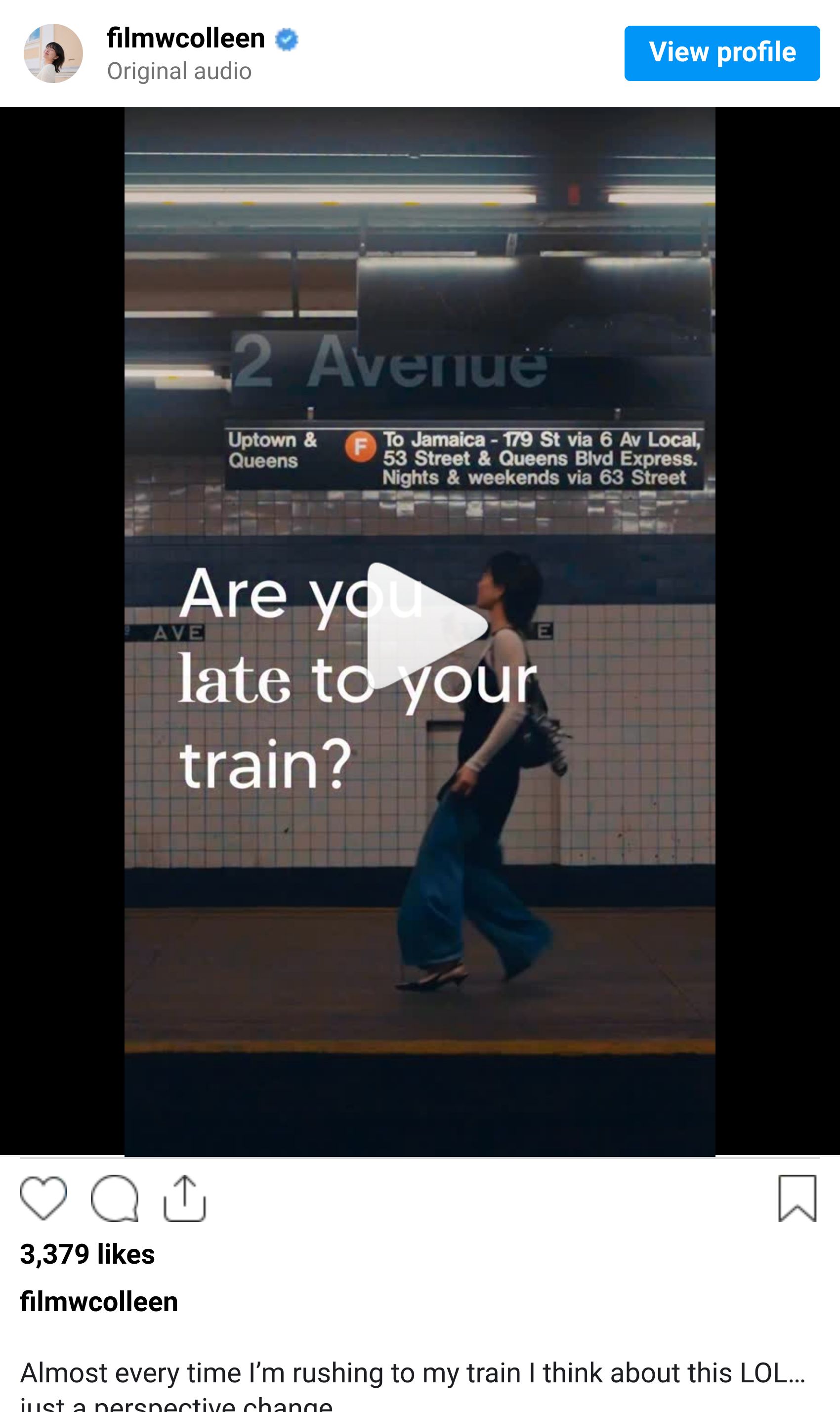
"Are you late to your train or Are you just early to the next one?" - Huan Huan (Colleen) Yu @filmwcolleen | I went to my bookmarks and liked videos, and I found the reel. It’s pretty short and is worth watching. Hope you love it as much (or more) as I did.
“The Myth of the ‘Brilliant’ Idea” – Lofi Cinema | This is one of the best video essays I’ve ever watched. It explained thoroughly and comprehensively a truth that we often overlook (or misunderstand). Frankly, the message can be applied outside of cinema. I can’t expound more. You just have to watch it. 😉
Want to share this issue of 4CW with a friend, colleague,… any human being? Just copy and paste this link: https://4creativewheels.beehiiv.com/p/april-9-2026 😉 😃
Thank you so much for reading!
As always, feel free to reply to this email & share your thoughts, stories, and any experience related to this topic. I’d love to hear them!
C ya next Week!
Embracing Creativity™,
Richard M.
Want to work with me? Contact me here
